
DSABNS 2027

Program

Accepted minisymposia for DSABNS 2027. Further details of the scientific program will be announced soon.

Accepted Minisymposia

We are pleased to announce the accepted minisymposia of DSABNS 2027. The five accepted minisymposia are presented below, together with a short overview and their submitted talk titles and presenters.

Scientific illustration for Computational Approaches to Chaos and Complex Dynamics in Biological Systems

Computational Approaches to Chaos and Complex Dynamics in Biological Systems

Organizers: Dimitri Breda, Jordi Ripoll, Martin Rosalie

Computational techniques for understanding nonlinear and chaotic dynamics in biological and natural systems. The session connects return maps, pseudospectral approximations, topological analysis of attractors, and spatial correlation closures to extract interpretable structure from complex models.

Talks and Presenters

  1. Numerical Evidence of Chaos in the Mackey–Glass Equation: Extraction of Tent MapsDavide Di Lenarda
  2. Investigating Symbolic Dynamics in Pseudospectral Approximations of Delay Differential EquationsRobert Szczelina
  3. Multiple Components Poincaré Section for Automatic Extraction of Unstable Periodic OrbitsSamuel Hocquart
  4. Beyond Pair Approximations: a Triplet Correlation Method for 2D Ecological Cellular AutomataGiulio Tirabassi

Scientific illustration for Infinite-Dimensional Population Dynamics: the many facets of spatiotemporal and structural heterogeneity

Infinite-Dimensional Population Dynamics: the many facets of spatiotemporal and structural heterogeneity

Organizers: Alberto d’Onofrio, Carmelo Filippo Munafò

How individual differences in age, location, history, and behaviour shape population-level dynamics. The talks bring together integral epidemic models, kinetic descriptions of disease and immune processes, and nonlocal spatial models, highlighting feedback, memory, and heterogeneous population structure.

Talks and Presenters

  1. Integral epidemic models with information-driven behavioural responsesBruno Buonomo
  2. An Integro-Differential Kinetic Framework for Disease Spread in Crowds: Social Behavior and Risk AwarenessDamián Knopoff
  3. Cross-Scale Feedback in a Kinetic Model of Immune Dynamics: The Case of Coeliac DiseaseDiletta Burini
  4. A nonlocal model for the spatial spread of a vector borne epidemic in an agro-ecosystem. Xylella as a case study.Vincenzo Capasso
Scientific illustration for Numerical Methods for Delay Equations and Structured Population Models in Biology

Numerical Methods for Delay Equations and Structured Population Models in Biology

Organizers: Davide Liessi, Alessia Andò

Numerical tools for biological models involving delays, individual structure, and stochastic effects. Contributions address new MatCont capabilities, state-dependent delay simulation, the challenges of populations structured by two physiological traits, and higher-order methods for stochastic delay differential equations.

Talks and Presenters

  1. New Functionalities in MatCont: Delay Equations and Lyapunov ExponentsDavide Liessi
  2. Numerical Simulation of State-Dependent Delay EquationsFerenc Á. Bartha
  3. Challenges in the numerical approximation to a Structured Population Models with two Physiological StructuresÓscar Angulo
  4. On Runge-Kutta Methods For Stochastic Delay Differential EquationsFaraz William
Scientific illustration for Decoding Outbreaks through Spatial and Social Contagion

Decoding Outbreaks through Spatial and Social Contagion

Organizers: Enrique Chipicoski Gabrick, Congjie Shi

Mathematical and computational perspectives on how mobility, contact-network structure, human behaviour, and spatial connectivity affect epidemic spread. The two-part minisymposium also examines real-time inference, outbreak persistence, awareness dynamics, and intervention strategies.

Talks and Presenters

Two-part minisymposium · 8 talks

  1. Impact of Topological Properties of the Public Transportation Network on the Spread of the COVID-19 PandemicAbdessamad Tridane
  2. Detecting Temporal Leadership in Dengue EpidemicsEnrique C. Gabrick
  3. Rare Regions in Excitable Models with Discontinuous Phase TransitionsPaulo H. Lorenzoni Filho
  4. Real-time Modeling of The 2025 Foot-and-mouth Disease Outbreak in The Hungary-Slovakia Border RegionOlivér Régaisz
  5. How Transmissibility and Social Structure Interact to Shape Pandemic OutcomesFabio Sartori
  6. How Higher-Order Interactions and Community Structure Shape Awareness and Epidemic DynamicsCongjie Shi
  7. A two-patch SEIR model with prevalence-dependent behavioural response and mobility for Ebola dynamicsAttila Dénes
  8. Group Centrality in Optimal and Suboptimal Vaccination for Epidemic Models in Contact NetworksMatheus Hansen
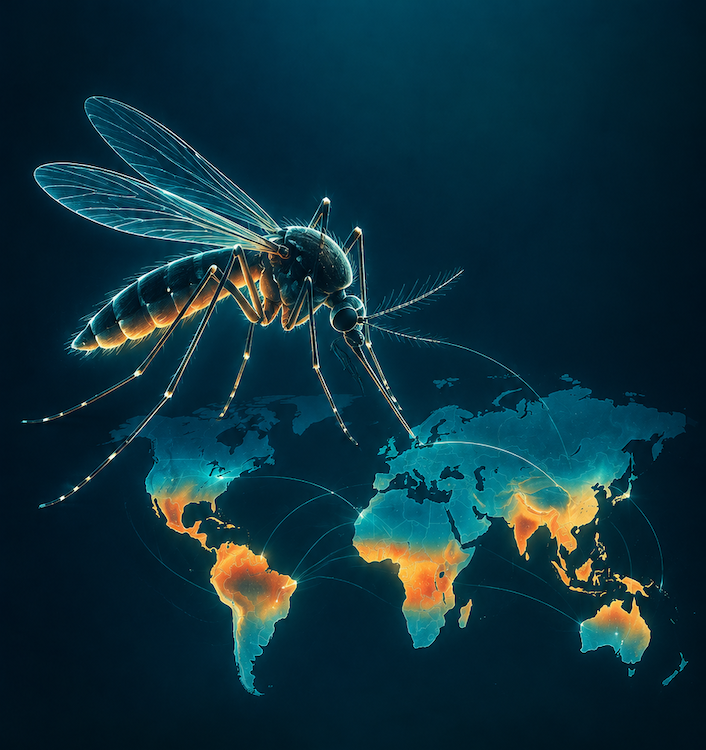
Scientific illustration for Mathematical Modeling Of Vector-Borne Diseases Under Climate Change

Mathematical Modeling Of Vector-Borne Diseases Under Climate Change

Organizers: Christian L. E. Franzke, Attila Dénes

Models of climate-sensitive diseases transmitted by mosquitoes and ticks, including the effects of temperature, rainfall, vector ecology, and environmental uncertainty. The talks combine future-risk projections, stochastic first-passage modelling, forest mosquito communities, and spatial risk mapping for tick-borne SFTS.

Talks and Presenters

  1. The Impact Of Natural Climate Variability On Future Vector-Borne Disease RisksRobin Thompson
  2. Stochastic Accumulation And First-Passage Risk: Toward Climate-Sensitive Vector-Borne Disease ModelsYongkuk Kim
  3. How Climate Change And Anthropisation Influence Mosquito Communities in Tropical ForestsMarc Hétier
  4. Systematic Modeling Of The Spatial Distribution Of Tick-Borne Severe Fever With Thrombocytopenia Syndrome (SFTS) Disease In South KoreaChristian L. E. Franzke

More program details coming soon

Information about the detailed schedule, contributed talks, and poster sessions will be published later on the website.

Registration & Submission